

Verification as an integration layer.
Vantage plugs into the connected-vehicle and asset infrastructure you already run. No new hardware to deploy. It cross-validates every telemetry stream against real-time physics, then hands you auditable, cryptographically signed verdicts you can stand behind in a warranty dispute or a safety review.
What verification changes for you.
Defend every claim
Signed evidence distinguishes genuine defects from misuse and sensor error, cutting unjustified warranty payouts and recall scope.
Predict, don't react
Physics-grounded prediction surfaces failures days ahead, turning unplanned downtime into scheduled maintenance.
Auditable by design
Every verdict carries a tamper-evident Evidence Bundle. Defensible in safety reviews, regulation, and disputes.
Layer, not rip-and-replace
Sits on top of your existing data pipeline via API. Weeks to value, not a hardware program.
One core, many domains
The same verification engine extends from passenger vehicles to industrial and critical assets.
Your data, your control
Verification runs against your streams without surrendering ownership or model transparency.
Regulators and buyers are done trusting black boxes.
Safety-critical AI is moving toward provable, auditable decisions. Verification stops being a nice-to-have and becomes the price of entry. Vantage is built for that world from day one.
From prediction to proof
It is no longer enough for a model to be right. You have to show why it was right. Evidence Bundles make that the default, not an afterthought.
From single-sensor to cross-validated
The next generation of monitoring assumes any one sensor can lie. Vantage was architected on that assumption, inverting the F1 pit-wall principle for safety.
Regulation is outlawing black-box AI in critical systems.
Across the EU, the UN's vehicle regulations, and India's incoming automotive rules, the direction is identical: decisions made by AI on physical infrastructure must be accurate, logged, auditable, and overseeable. That is exactly the shape of what Vantage produces.
High-risk AI, phasing in 2026–27
AI used as a safety component in critical infrastructure is classified high-risk: accuracy, logging, transparency, and human oversight become legal requirements, not best practice. Vantage's evidence-first architecture is built for precisely this bar.
Mandatory from February 2027
EV and industrial batteries above 2 kWh will require auditable lifecycle and state-of-health records. Vantage's battery models and tamper-evident evidence chains are designed to feed exactly this kind of verified record.
Vehicle cybersecurity management
OEMs must run certified management systems that monitor, detect and respond to attacks on vehicles in the field, with logs that support forensic analysis. Vantage supports those obligations: physics-based detection of sensor spoofing and manipulation, and signed evidence for every verdict. India's AIS-189 mirrors R155, with mandatory rules now in draft.
Security by design, continuous posture
Europe's product-security and infrastructure rules push manufacturers and operators toward continuous monitoring and provable security posture. We build Vantage and its edge hardware to be CRA-ready for EU deployment, and its audit trail helps you demonstrate your own.
Start in automotive. Extend anywhere readings can deceive.
Not hypothetically: five verticals already run on the same core, and the second production-grade vertical, an industrial bottling line with 37 telemetry signals and 34 physics-verification rules, was stood up as configuration, with no changes to the platform.
Fleet-wide intelligence, without fleet-wide exposure.
The objection every data-sensitive OEM raises: "We can't pool our vehicles' data." You don't have to. Vantage improves shared models across your fleet through federated learning, the models learn from each asset locally and only the learnings are combined, never the raw data.
No central data lake
No user or vehicle is ever connected to a specific dataset. In a worst-case breach, there is no raw data pooled to expose.
Provable, not promised
Differential privacy on shared updates, secure aggregation so even the operator sees only the combined result, and optional hardware attestation. See the four layers →
On-device option
For commercial fleets running edge-capable hardware, basic anomaly detection can run on the device, so that raw telemetry need never leave the asset. Optional for deployments that add hardware; the default PaaS layer runs in your infrastructure.
Your engineers stay in control. The physics keeps them honest.
Vantage is not a black box you file tickets against. Your domain experts tune it themselves, inside guardrails that make every change safe, and provable.
Tune constraints, within physical floors
Thresholds, envelopes, and rule bounds are tunable per tenant, and every change is clamped to hard physical limits. Safety-critical constraints can be locked to view-only.
Every change is on the record
Each edit is attributed and bound into the tamper-evident evidence chain, so "who loosened what, by how much, on which alert" always has a provable answer.
Author new domains without code
Signals, thresholds, verification rules, and a working digital twin composed from a shared physics catalog: a complete governed domain can be stood up declaratively from the console, and validated before it activates.
Models only get stricter
Customer-facing model promotion is held to a stricter-than-default-only bar, and the learning core itself stays sealed, so tuning can never quietly degrade verification.
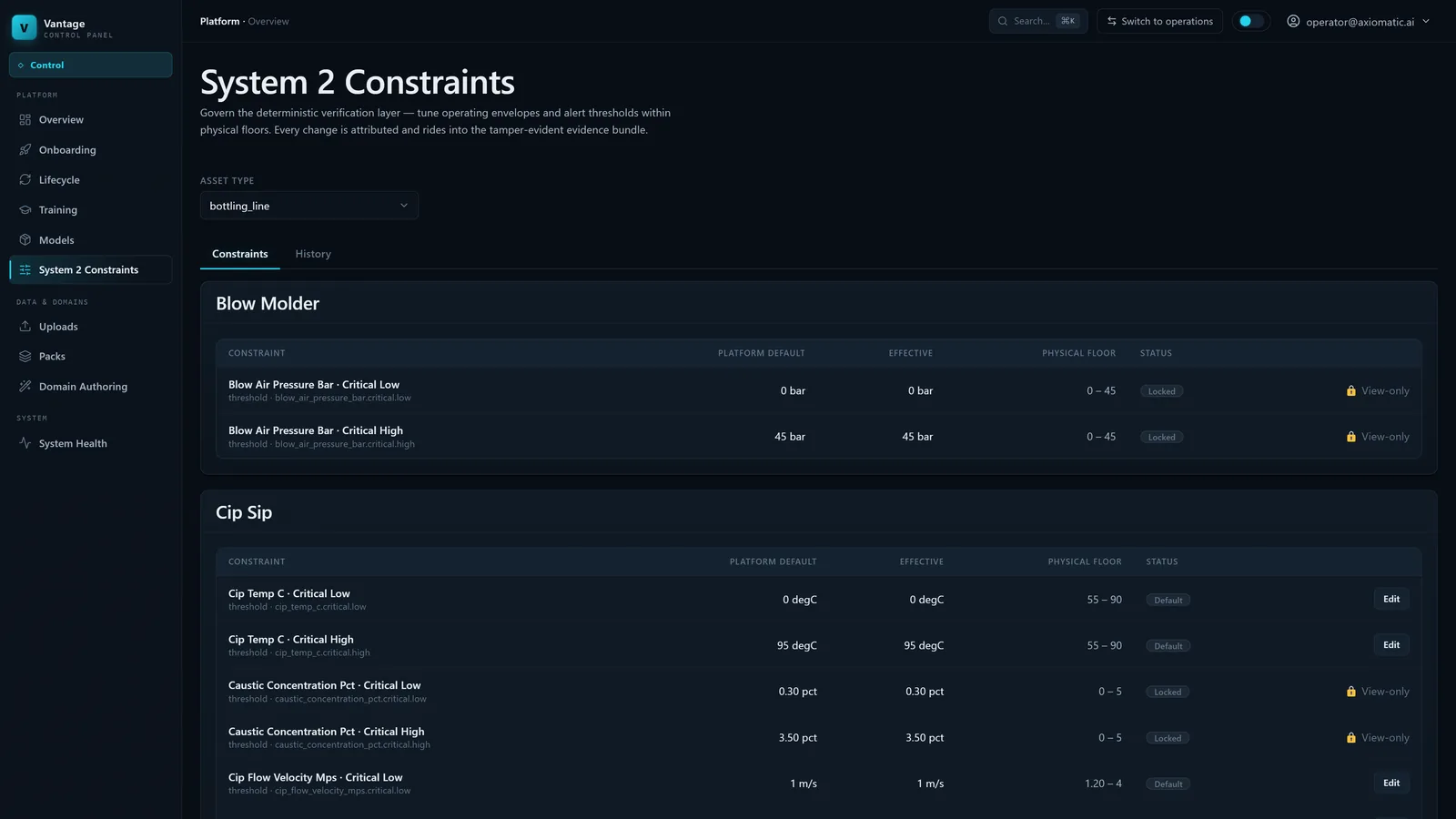
Constraint governance · physical floors & locks · demo data
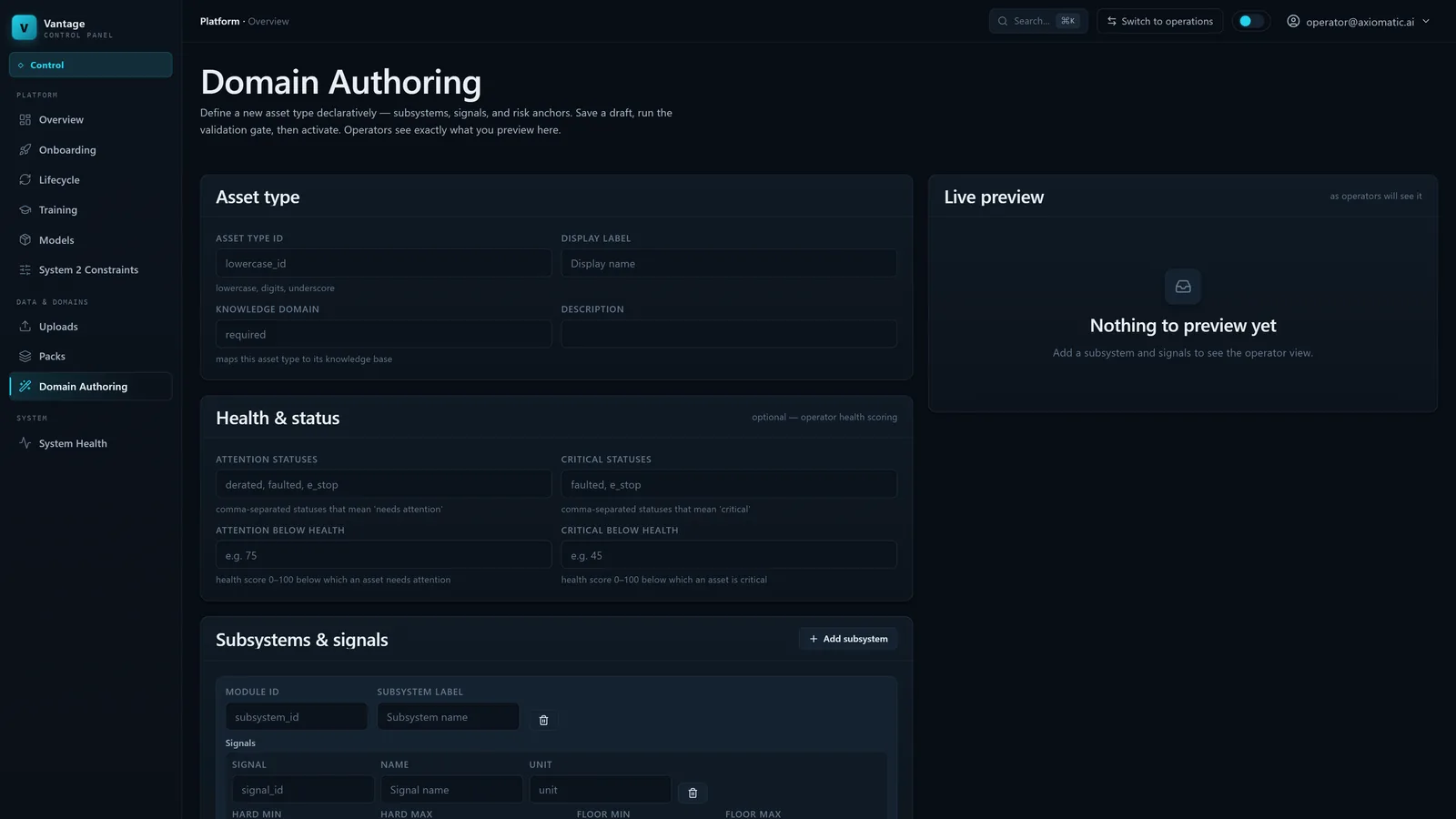
Declarative domain authoring · validation-gated · demo data
Shadow mode first. Weeks, not quarters.
Runs alongside, changes nothing
Pilots deploy in shadow mode next to your existing monitoring: Vantage verifies the same streams, and you compare its verdicts against what actually happened.
4–6 weeks, typical
You bring sample telemetry, system topology, and operating modes. We bring the propose-and-verify loop and evidence-backed outputs against your own data.
Your infrastructure, if you prefer
Containerized deployment to your private cloud, on-premise servers, or air-gapped environments. Verification comes to your data, not the other way around.
See the architecture. Bring your hardest case.
A 45-minute technical session: how Vantage integrates with your stack, how Evidence Bundles work, and where verification moves the needle on your warranty and uptime numbers.